
Introduction
Social media engagement for a B2B brand is about humanising your brand, establishing authority, and building genuine relationships with decision-makers who scroll through social feeds.
But the real challenge remains the same: how do you directly connect with the audience and grow the revenue? Without a content strategy, you’re just creating noise. This guide breaks down how to build a content strategy for B2B brands.
Why do you need a social media strategy?
A social media strategy gives your brand a clear direction. It outlines what to post, why to post it, and how it supports your business goals. Randomly chasing trends won’t build engagement or generate leads.
A solid strategy begins with brainstorming, creating concepts, and mapping them into a structured content plan. This becomes your social media calendar, ensuring every post follows your brand tone, purpose, and objectives.
Highlights:
5 Key strategies for social media marketing
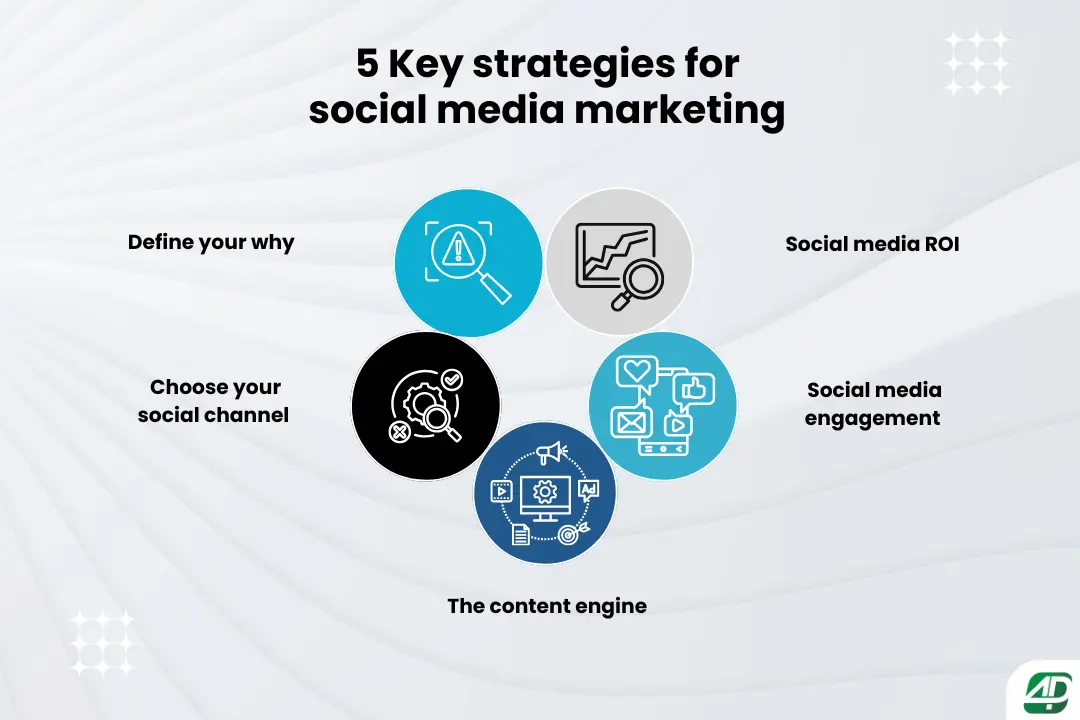
1. Define your why :
Before you draft a single caption, you must know why you are doing it. For a social media strategist, aligning social goals with business objectives is the difference between a "nice-to-have" channel and a lead magnet account.
Here are the common objectives that you can have:
- Brand Awareness: Increasing share of voice within your specific industry niche.
- Demand Generation: Educating the market on the problems your product solves.
- Lead Generation: Driving traffic to gated content, webinars, or demo requests.
Pro Tip: Don’t try to do everything at once. Pick one primary goal per quarter to keep your strategy focused.
2. Choose your social channel :
While X, Instagram and Facebook have their place in B2B social media strategy, LinkedIn marketing remains the constant champion. For networking and B2B lead generation through social media.
Why? Because context matters. LinkedIn users are basically business-minded people; hence, they consume content such as industry insights, new trends with networking opportunities, and solutions to professional problems. For a B2B brand, you can create content for below social channels apart from LinkedIn.
- X (formerly Twitter): Great for real-time industry conversations, events, and customer support.
- YouTube:The second-largest search engine, ideal for deep-dive educational content and product demos.
Focus your social media channels where your audience is. LinkedIn marketing for a B2B brand is the best choice because that's where most of your niche clients are.
3. The content engine :
The central part of any social media strategy is deciding what to post. Hence, you need a mix of content that serves different stages of the funnel. Here are three pillars to guide your B2B social media content ideas:
- The Educator (Top of Funnel): Stop selling and start teaching. Position your brand as the helpful expert. What to post? Industry trend analysis, "How-to" carousels, infographics breaking down complex data, and snippets from blog posts.
- The Humanizer (Middle of Funnel): People buy from people, hence humanize your brand. Show the faces behind the logo. What to post? Employee spotlights, behind-the-scenes office tours, photos from industry events, values-driven posts.
- The Validator (Bottom of Funnel): Prove that you deliver results. What to post? Client testimonials, case study snapshots, award announcements, third-party reviews.
Expert advice: A smart content strategy for B2B brands usually follows the 4-1-1 rule: For every 6 posts, 4 should be educational/entertaining, 1 should be a soft sell (like an event invite), and only 1 should be a hard sell (demo request).
4. Social media engagement :
Posting is only half the battle. If you aren't engaging, you are broadcasting, not socializing. Algorithms favor accounts that spark conversation. Social media engagement for B2B requires a proactive approach:
- Community Management: Reply to every comment on your posts. Ask follow-up questions to keep the thread alive.
- Outbound Engagement: Don't just wait for people to come to you. Have your social team (or executives) comment on the posts of industry influencers, partners, and prospects. Add value to *their* conversations.
- Employee Advocacy: Your employees likely have 10x the reach of your brand page. Empower your team to share company content with their own commentary. This "human" reach is gold for algorithms.
5. Social media ROI :
For many marketing heads, the question is always: "What is the return?" Measuring B2B social media ROI can be tricky because the attribution path is non-linear. However, you must move beyond vanity metrics (likes and followers) to business metrics.
Metrics to track:
- Engagement Rate: (Total interactions / Total followers) x 100. This indicates content resonance.
- Click-Through Rate (CTR): Are people actually leaving the platform to visit your site?
- Conversion Rate: Use UTM parameters on every link you share. This allows you to track exactly which social post led to a form fill in Google Analytics.
- Cost Per Lead (CPL): If you are running paid ads, how much does it cost to acquire a lead via LinkedIn vs. Google Ads?
How The 4P Solutions can help you?
The secret ingredient to a strategy that works isn't viral content; it's consistency. B2B sales cycles are long. You need to show up, add value, and engage consistently so that when your prospect is finally ready to buy, your brand is the first one they think of.
At The 4P Solutions, we are a social media agency and have been in the industry for a decade. We build strategies with keeping in mind the engagement and ROI. With the data-driven strategies, the posts are created with a variety of goals to target your niche audience. To plan your social media strategy, connect with The 4P Solutions at mktg@the4psolutions.com or call us at +91 85919 37177 to learn more.
Conclusion
At The 4P Solutions, we craft social media strategies for B2B brands that perform well, from content creation to performance tracking. To turn your social media channels into genuine business assets, connect with us to be your social media marketing partner
FAQ’s:
You can track the KPI’s such as CTR, engagement rate, and conversion rate to get the overall idea.
Start with market research, your audience persona, choosing the right social channel, and using the brand tone to push your social media ad to your audience.
You can take inspiration from other posts and generate ideas to create a unique, creative post that has eye-catching elements to boost it.